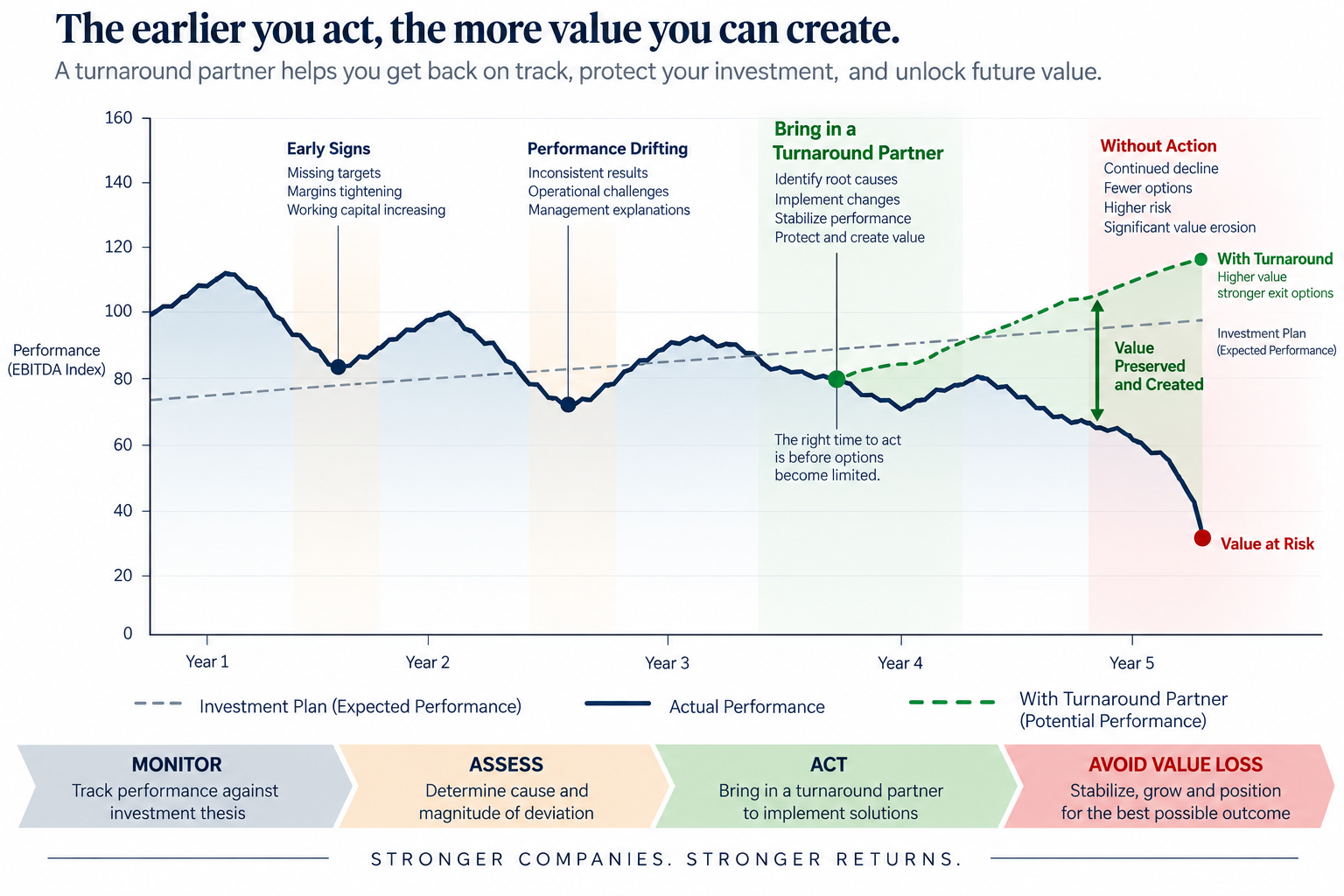

When people hear the word “turnaround,” they often picture a company in serious financial distress.
Cash is running out. Lenders are concerned. Vendors are tightening terms. Covenants have been breached. Management is overwhelmed, and everyone is trying to figure out how much runway remains.
That is certainly when turnaround expertise can be valuable.
But it is not necessarily when it is most valuable.
For asset managers, private equity sponsors, family offices, and others responsible for investment portfolios, there is an earlier point that deserves just as much attention.
It is when a portfolio company simply stops performing the way it was supposed to.
It Usually Doesn’t Start With a Crisis
The warning signs can initially look manageable.
Revenue misses the plan.
Margins decline a few points.
Working capital requirements increase.
Receivables begin aging.
Inventory grows faster than sales.
Customer acquisition becomes more expensive.
A major account leaves.
Employee turnover increases.
Management revises the forecast.
None of these necessarily means the company is in distress.
The problem is when several of them begin happening at the same time.
That is when an investor needs to determine whether the company is experiencing normal volatility or whether something more fundamental has changed.
Go Back to the Investment Thesis
Every investment starts with a thesis.
Maybe the company was expected to grow into new markets. Perhaps margins could be improved through operational efficiencies. There may have been an opportunity to consolidate a fragmented industry, introduce better technology, professionalize management, expand the sales organization, or make add-on acquisitions.
Whatever the thesis was, there were assumptions about how value would be created.
When performance starts slipping, one of the first questions should be simple:
Is the original investment thesis still valid?
The answer may be yes.
The opportunity may still exist, but execution has fallen short.
Or the answer may be more complicated.
The market may have changed. Customer behavior may have shifted. Costs may have permanently increased. Technology may be changing the competitive landscape. A management team that was right for a smaller organization may be struggling to operate a larger one.
AI is adding another variable. PwC notes that private equity firms are increasingly evaluating both how portfolio companies can use AI to improve productivity and growth and whether existing business models could be disrupted by more technologically advanced competitors.
The important thing is finding out what changed before simply putting more capital behind the original plan.
The Numbers Tell You What Happened. Operations Can Tell You Why.
Financial performance is where problems eventually become visible.
But the cause is often somewhere else.
Declining EBITDA could originate with pricing.
A cash problem could actually be an inventory problem.
A revenue problem could be a sales process problem.
A margin problem could be caused by scheduling, purchasing, labor utilization, scrap, overtime, or an unprofitable customer mix.
Poor forecasting could actually be a data problem.
That is why evaluating an underperforming portfolio company requires getting underneath the financial statements.
Someone needs to look at how the company actually operates.
Walk the floor.
Talk to supervisors.
Review scheduling.
Examine inventory.
Look at purchasing.
Understand customer profitability.
Review the sales pipeline.
Evaluate the technology stack.
Test the assumptions behind management’s forecast.
Look at what is happening with people, processes, customers, and cash.
The objective is to connect the financial result to the operational cause.
Waiting Has a Cost
One of the most difficult decisions for an asset manager is knowing when to intervene.
Intervene too quickly and management may feel that ownership is unnecessarily inserting itself into the business.
Wait too long and the available options may become considerably less attractive.
That is why the trigger for intervention should not necessarily be financial distress.
It can simply be persistent deviation from the investment plan without a credible path back.
Current private capital conditions make that increasingly important. PwC reports that portfolio companies are remaining private longer, while constrained exit opportunities are forcing sponsors to think differently about how value is created during extended holding periods. A 2026 Alvarez & Marsal survey similarly points to a widening gap between diligence assumptions and actual operational execution.
Another year of ownership can create tremendous value if the company is improving.
Another year of underperformance can do exactly the opposite.
A Turnaround Can Be a Value-Creation Strategy
This is where the definition of turnaround needs to change.
A turnaround is not necessarily about saving a failing company.
For an investment portfolio, it can be about protecting an investment that is beginning to move in the wrong direction.
That might involve improving working capital, changing pricing, eliminating unprofitable business, correcting operational inefficiencies, improving throughput, strengthening sales execution, introducing better reporting, addressing leadership gaps, or using technology and AI to improve productivity.
It can also mean challenging assumptions that no longer make sense.
The objective is to identify what is preventing the company from creating value and then execute against it.
Recent industry research reflects this shift toward operations. Alvarez & Marsal reported in May 2026 that active operational value creation accounted for half of EBITDA growth among surveyed PE respondents in a more challenging environment.
That makes operational intervention more than a defensive strategy.
It can be an investment strategy.
Sometimes the Answer Isn’t “Fix It”
There is another reason to intervene early.
Not every portfolio company should be turned around indefinitely.
Once an independent assessment establishes what is really happening, ownership may determine that the company should be stabilized and returned to its growth plan.
But there are other possibilities.
It may make sense to change leadership, recapitalize the business, sell a division, pursue an acquisition, restructure operations, prepare the company for sale, or begin an orderly exit.
The purpose of intervention is not to preserve the company at any cost.
It is to preserve and maximize investment value.
The earlier those conversations occur, the more choices investors typically retain.
Independent Eyes Matter
Management teams naturally live inside their businesses.
They know the history behind every decision. They understand why something was delayed, why a customer was lost, why a forecast changed, and why an initiative did not produce the expected result.
That knowledge is valuable.
It can also make it difficult to see the company from an investor’s perspective.
An experienced turnaround team provides a different view.
The job is not simply to produce another report. It is to determine what is happening, establish priorities, and work alongside management to execute the changes that matter.
For an asset manager overseeing multiple investments, that outside perspective can also answer a critical capital-allocation question:
Is additional capital likely to create value, or will it simply fund continued underperformance?
Protecting the Portfolio Starts Before Distress
The strongest time to address an underperforming investment is not necessarily when everyone agrees there is a problem.
It is when the warning signs first suggest that the company is moving away from the plan.
A turnaround at that stage can look very different from a traditional restructuring.
There may still be liquidity.
Customers may still be confident.
Lenders may still be supportive.
Employees may not know there is a problem.
And ownership still has options.
That is precisely why acting early can matter.
For asset managers, the question should not simply be:
Which companies in our portfolio are distressed?
A more useful question may be:
Which investments are no longer creating value at the rate we expected, and what needs to change before that becomes a much bigger problem?
At 360 Veritas, we work inside businesses to identify the financial and operational causes of underperformance and help management and ownership execute the changes needed to stabilize performance, improve value, and determine the strongest path forward.